The ocean has always had a dark side. Long before Halloween was a thing, sailors were telling stories about what lurked beneath the surface, and the Cornish coast was adding its own legends to the pile.
This Halloween, we are leaning into it. Below you will find the ocean’s most spectacularly named creatures (all harmless, all fascinating), some of the darkest folklore from the coastline you cross on our trips, and a marine wildlife quiz to finish. See how you get on.
Part One: Six Genuinely Terrifying Marine Creatures
They sound like monsters. They are not. But they are extraordinary.
1. Vampire Squid (Vampyroteuthis infernalis)
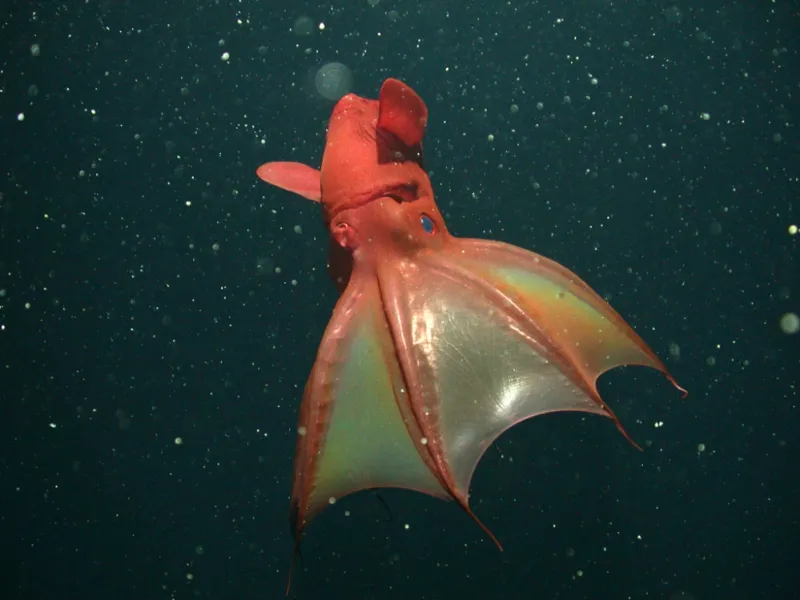
[Photo credit: Smithsonian National Museum of Natural History]
Vampyroteuthis infernalis translates, roughly, to “vampire squid from hell.” It has blood-red skin, a cloak-like webbing between its arms, a white snapping beak, and hooks along its eight limbs.
It is also about the size of a rugby ball, and completely harmless.
Despite the name, vampire squid share almost nothing with actual vampires, and they are not technically squid either. They are the only surviving member of their own distinct order, sitting somewhere between squid and octopus in the evolutionary tree.
For a long time, scientists assumed they were predators lurking in the dark. Then in 2012, researchers at the Monterey Bay Aquarium Research Institute discovered what they actually eat: marine snow, tiny particles of organic matter that drift down from the surface. The vampire squid unfurls two long filaments, up to eight times the length of its body, and drifts through the water collecting them. Gentle, patient, nothing like its name.
They live at 600 to 1,200 metres depth, in the ocean’s oxygen minimum zone, conditions that would be lethal for most marine life.
2. Sea Lamprey (Petromyzon marinus)
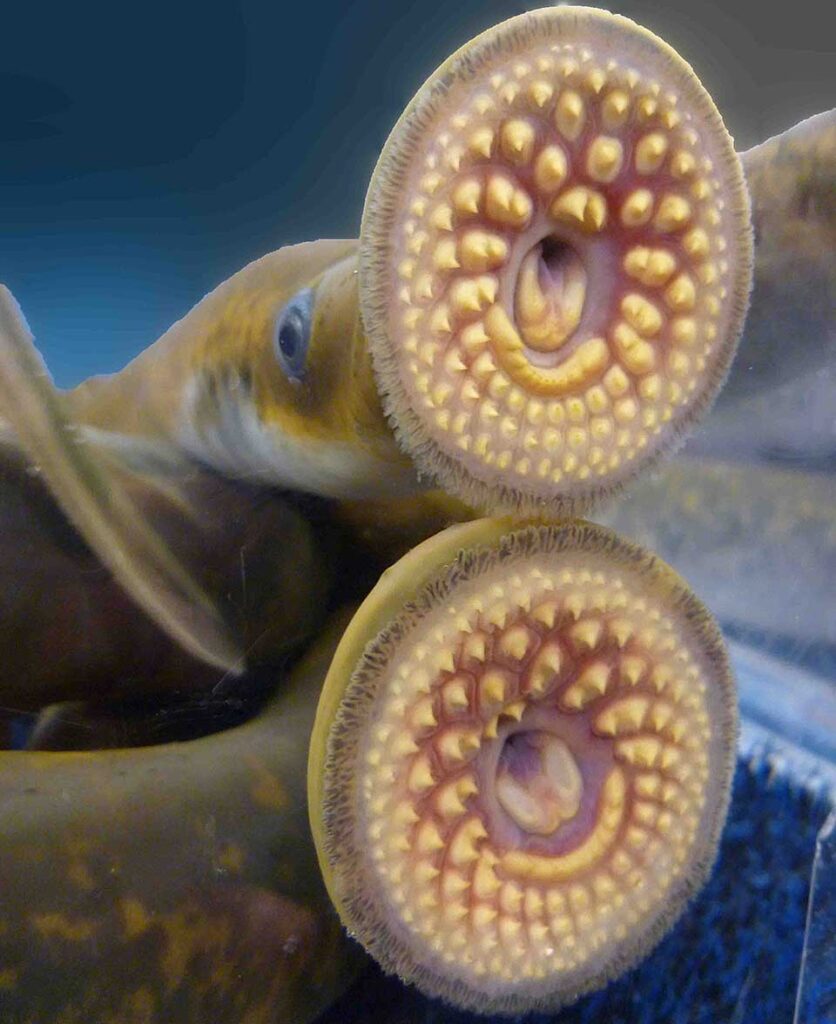
[Photo credit: NOAA]
The sea lamprey earns its “vampire fish” nickname more honestly. A jawless, scaleless fish with a circular suction-cup mouth ringed with concentric rows of sharp teeth, it attaches to other fish and feeds on their blood and bodily fluids, secreting an anticoagulant to keep the flow going.
They survive at depths of up to 4,000 metres and tolerate a wide temperature range, making them one of the ocean’s more adaptable species. They are also migratory: adults travel into rivers to spawn, laying eggs in clean gravel beds before dying.
Sea lamprey are an ancient lineage, largely unchanged for around 360 million years. They have outlasted the dinosaurs comfortably.
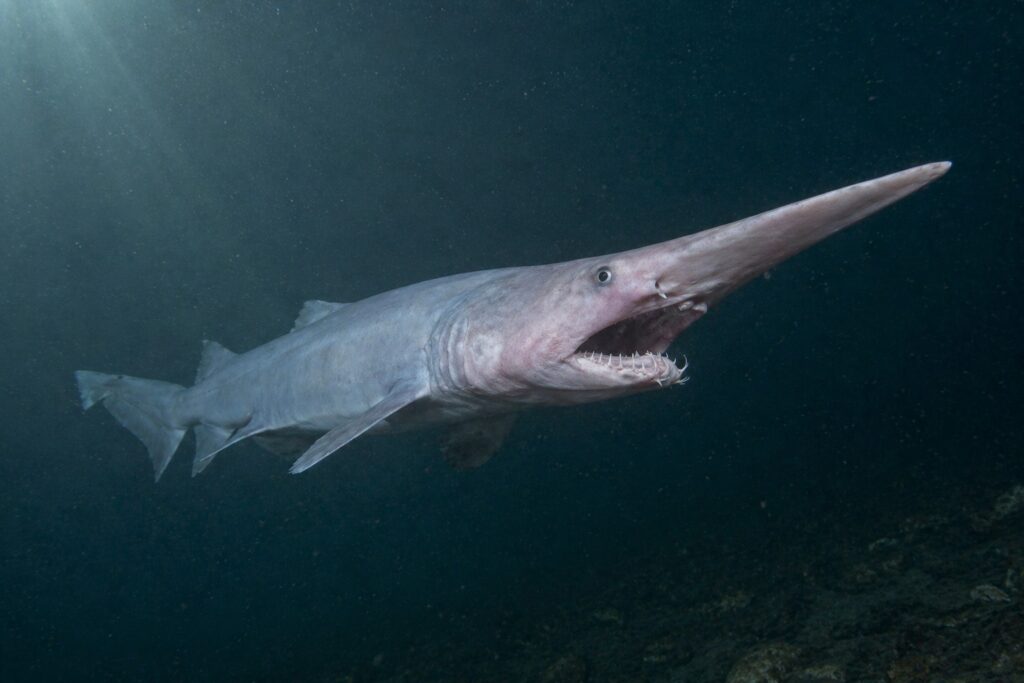
3. Goblin Shark (Mitsukurina owstoni)
[Photo credit: Outforia]
The goblin shark has a long, blade-like snout projecting from its forehead and jaws that fire forward rapidly to snatch prey, a feature called slingshot feeding. It lives below 1,300 metres and is rarely seen.
Despite the appearance, it is not aggressive. It eats small fish, crustaceans and cephalopods. Its lineage dates back around 125 million years, effectively unchanged since then, making it one of the ocean’s oldest surviving shark families.
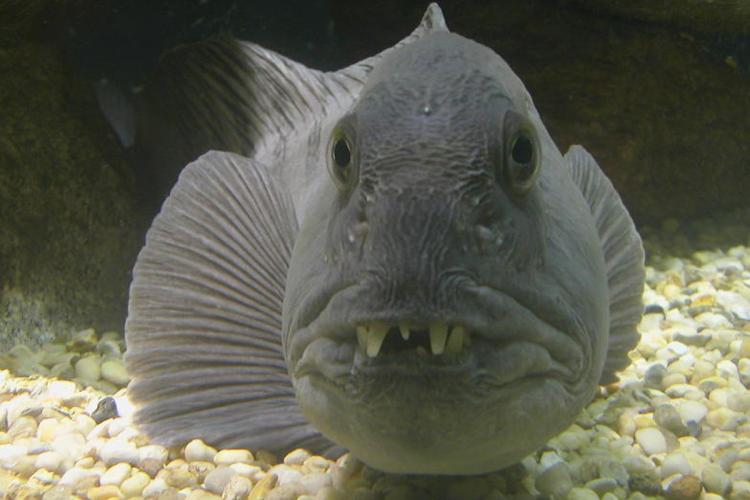
4. Wolffish (Anarhichas lupus)
[Photo credit: NOAA Fisheries]
The wolffish (also called the seawolf) has a jaw full of large, formidable teeth, designed for crushing hard-shelled prey like sea urchins and clams rather than anything more dramatic. It is a slow-moving, shy fish found at depths over 600 metres in the North Atlantic.
One genuinely unsettling detail: for a brief period after death, the jaw muscles continue to function. A dead wolffish can, technically, still bite. Not a practical hazard for anyone, but it does make them memorable.
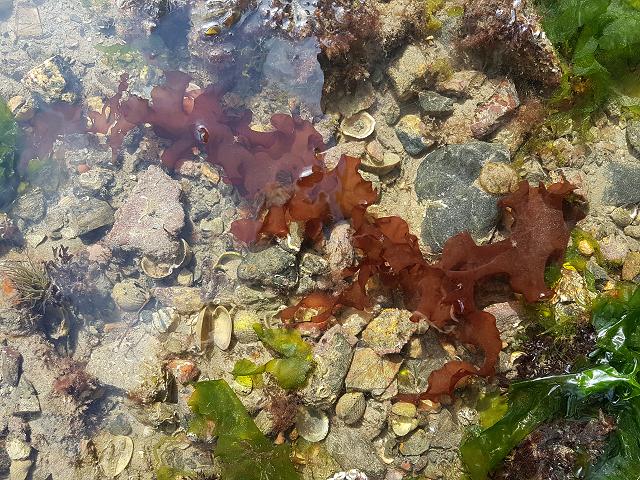
5. Devil’s Tongue Weed (Grateloupia turuturu)
[Photo credit: Seaweed.ie]
Not every spooky marine species is an animal. Devil’s tongue weed is a vivid dark red seaweed with a twisted, tongue-like shape and a notably slimy texture. It turns up in intertidal rock pools around the UK coast, somewhere between alien and unsettling at first glance.
It is a non-native species from East Asia that has established itself in UK waters. It does not currently appear to pose a significant threat to native marine ecosystems, though it is monitored as an invasive.
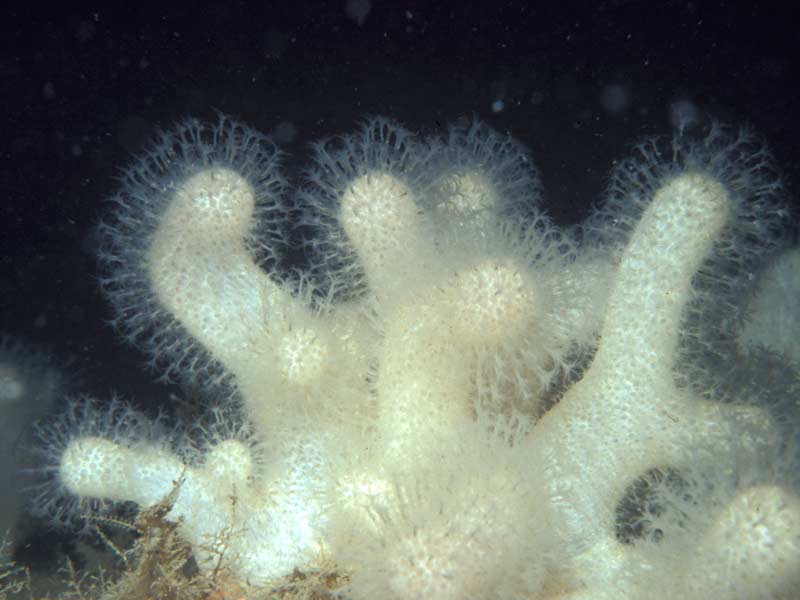
6. Dead Man’s Fingers (Alcyonium digitatum)
[Photo credit: MarLIN.ac.uk]
Dead man’s fingers is a soft coral native to UK coastal waters. It grows in thick, lobed masses on submerged rocks and wrecks down to around 50 metres. Exposed at low tide or washed ashore, the colonies look strikingly like bloated, pale fingers reaching out of the rock.
It is, in reality, a living coral colony, each lobe packed with tiny polyps filtering food from the water. Completely harmless, and genuinely beautiful underwater when the polyps extend and the whole colony comes alive.
Despite their names and appearances, every creature on this list is harmless to humans. The deep sea has produced some of the most extreme adaptations on earth, but almost none of them are aimed at us.
Part Two: The Dark Folklore of Our Coastline
The North Cornwall coast is beautiful. It is also ancient, and it carries stories in its place names and cliffs that are considerably darker than the view suggests. Here are three legends from places you pass on our trips.
The Mermaid of Padstow and the Doom Bar
Anyone who has been on one of our trips will have crossed the Doom Bar, the sandbank at the mouth of the Camel Estuary that has claimed as many as 600 vessels over the centuries. Thanks to modern dredging, it poses little danger today. But it was not always there, and legend says it was not there by accident.
The story varies, but it is always one of unrequited love.
A mermaid had lived peacefully in Padstow Bay for years, watching over the harbour and warning sailors of incoming storms. Then came a fisherman, and things went wrong.
In one version, she fell desperately in love with him. He did not love her back. She tried to drag him beneath the waves; he shot her to survive. In her dying moments she cursed the harbour, hurled a handful of sand toward the estuary, and sank beneath the water for the last time. That night a storm raged. The next morning, the Doom Bar had appeared.
In another version, the fisherman was hunting young seals when the mermaid came to tell him to stop. He fell for her; she wanted nothing to do with him, only to protect the seals. He shot her anyway. Same ending either way.
The mermaid was never seen again. The sandbank remained.
[Photo credit: Mikes Cornwall, Doom Bar]
Mother Ivey and the Cursed Field
You may have stayed at Mother Ivey’s Bay or watched the RNLI lifeboat deploy from the station at the point. In the 1600s, the village then called Polventon was gripped by poverty. A single wealthy merchant controlled the pilchard trade and lived in a cottage called the Cellars, between Harlyn Bay and Mother Ivey’s Bay. Above the door, an inscription that still reads today: Dulcis Lucri Odor, meaning “Profit Smells Sweet.”
One season, a catch went unsold. Mother Ivey, a witch and healer of the village, implored the merchant to give the fish to the starving townspeople. He refused, and ploughed them into his field as fertiliser.
She cursed the ground. She declared that if the soil were ever broken again, death would follow.
The merchant ignored this and continued farming. His son was thrown from a horse in that field and killed.
In the 1970s, a metal detectorist collapsed and died in the same field.
By 1997, the superstition had grown so strong that South West Water could only obtain permission to lay pipes beneath the field after having it blessed by a priest. The blessing was considered sufficient. The field still lies unused today. One local farmer, it is said, would not work it for any money.
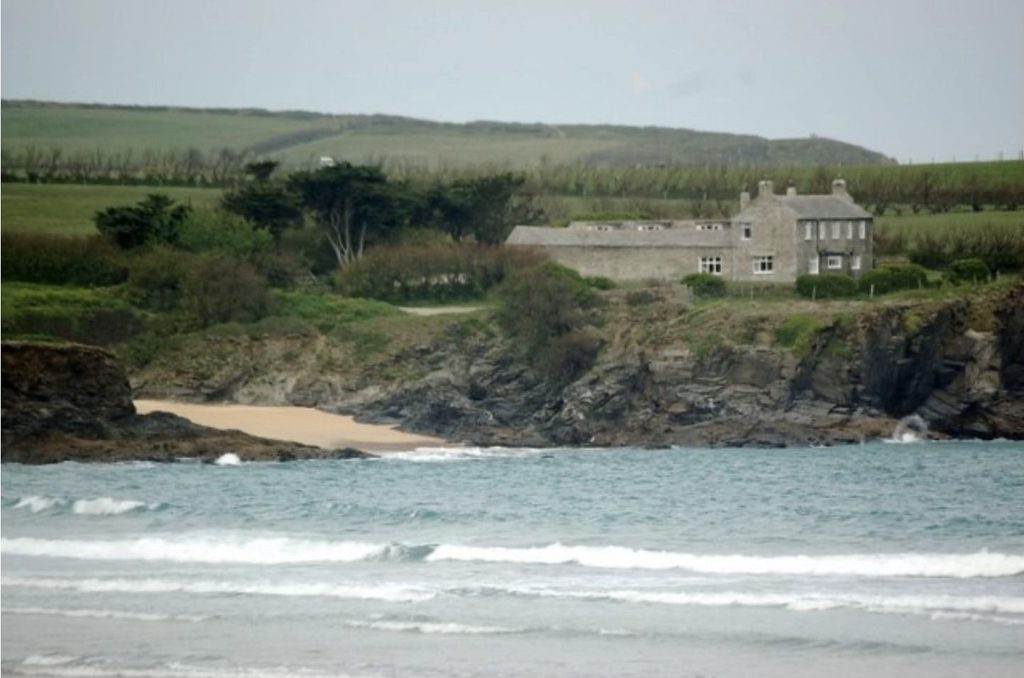
[Photo: The Cellars cottage between Harlyn and Mother Ivey’s Bay, by Mari Buckley]
The Ghost Village of Port Quin
Port Quin, from the Cornish Porthgwynn, meaning “White Haven”, now looks like a picture-perfect turquoise cove. A peaceful, almost secret bay. It was not always so.
Port Quin was a prosperous fishing village from at least the 12th century. Then, one evening, all the men of the village were lost to an unseasonal storm. The exact date shifts depending on which account you read. Some versions say it happened because the men had broken the sabbath, they went out to fish on a Sunday.
Whatever the cause, the result was total. The widows, the fatherless children, the elderly, all were left without anyone to bring in a living. Unable to survive, they abandoned their homes and left. Port Quin became a ghost village.
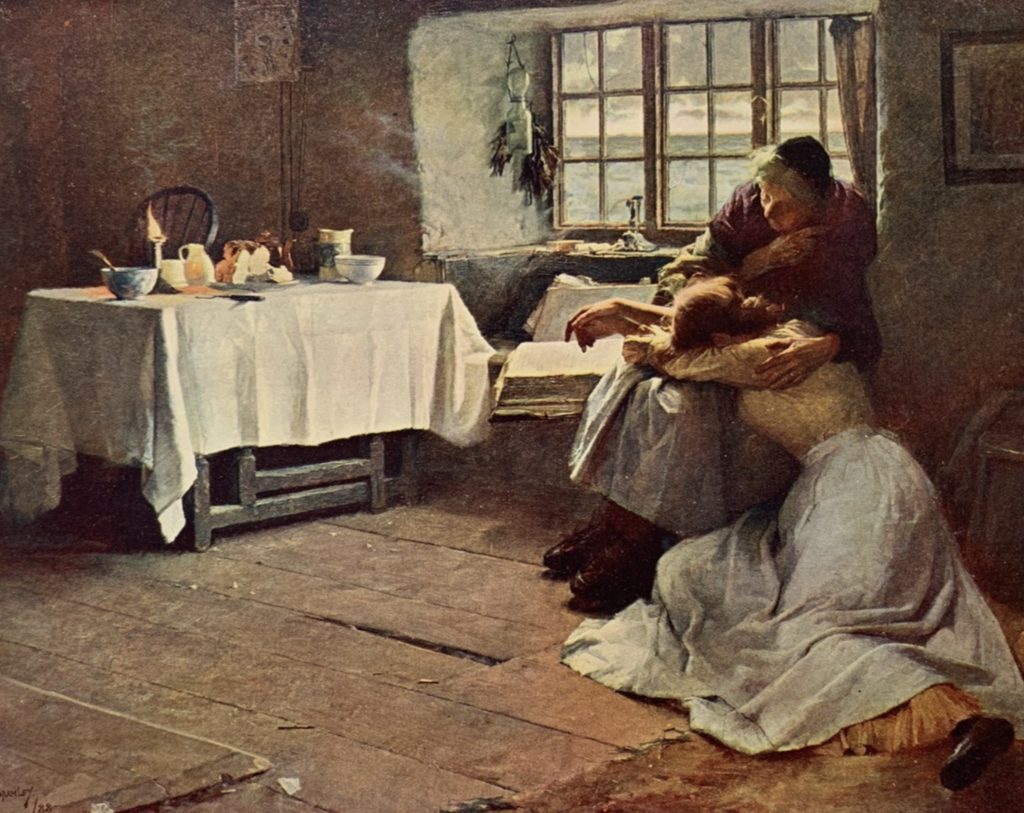
The painting A Hopeless Dawn by Frank Bramley, a widow watching the grey morning light after losing her husband at sea, was inspired by this legend.
Today Port Quin is peaceful. But the silence carries something with it.
Part Three: Guess the Marine Animal from Its Skeleton
Ready to test your knowledge? Here are three marine animals, identified only by their skeletons. See if you can place them.
Round
Which marine mammal has a long skull, a flexible spine and flipper-like limbs?
Hint: they can often be seen hauled out on islands and secluded coves along the North Cornwall coast.
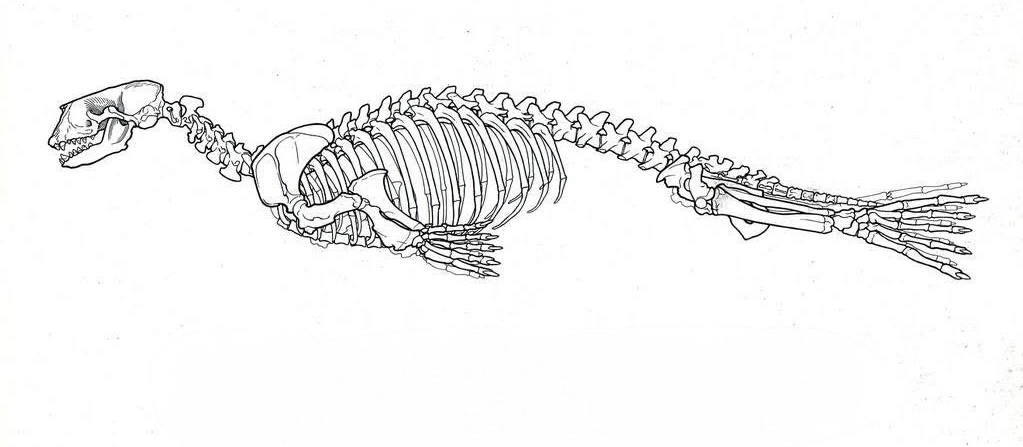
[Photo credit: Ythen Seal Watch]
A. Grey seal B. Bottlenose dolphin C. Harbour porpoise
Answer: It’s the grey seal!
The grey seal’s flexible spine and streamlined skeleton help it move through water with surprising ease, while its powerful flippers steer and propel it. On land, seals move very differently, wriggling and shuffling rather than walking. Grey seals can dive for several minutes at a time and use their sensitive whiskers to detect the movement trails left by fish in the water.
You can spot grey seals year-round on our Seal Safari trips.
Round 2
Which marine mammal communicates in clicks and squeaks, travels in pods, and is considered one of the most playful species in our seas?
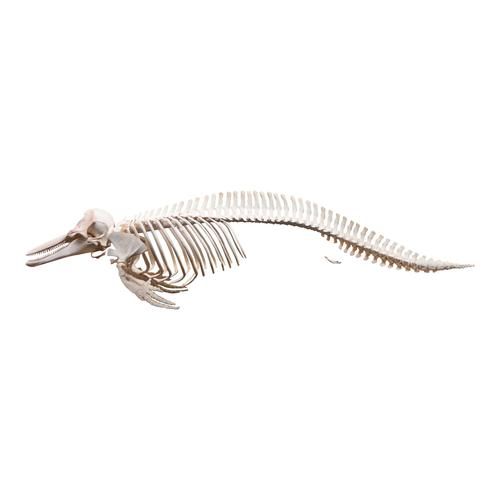
[Photo credit: Skulls Unlimited]
A. Minke whale B. Bottlenose dolphin C. Grey seal
Answer: It’s the bottlenose dolphin!
Dolphins use clicks for echolocation, sending out sound pulses and listening for the echoes to locate prey and navigate underwater. They also produce whistles and other sounds to communicate with each other within the pod. Bottlenose dolphins can live an average of 45 to 50 years.
Read our guide to dolphin spotting in Cornwall to find out more about what makes this coastline such a rich habitat for them.
Round 3
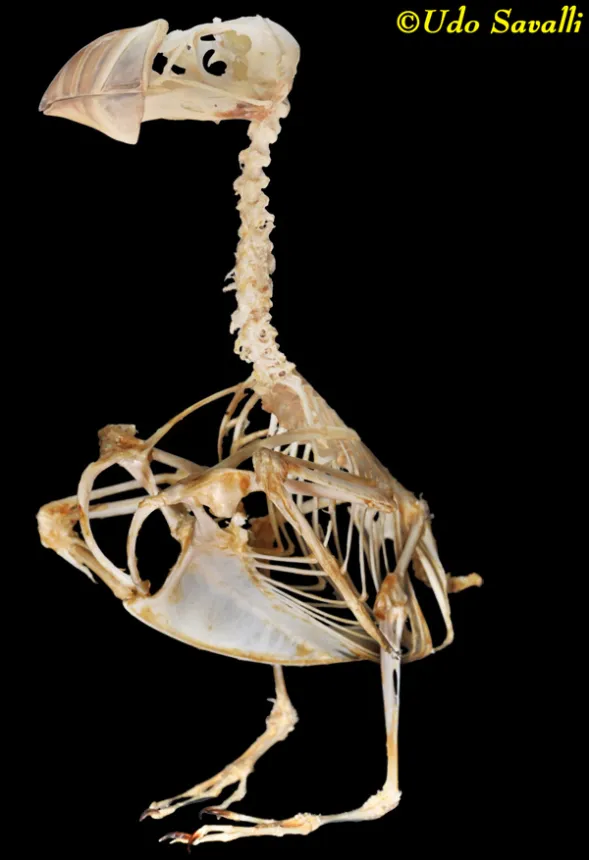
These birds are sometimes called “little clowns of the sea.” They spend most of the year far out at sea, only returning to land to breed. The collective noun for a group of them is a circus.
[Photo credit: Udo Savalli]
A. Atlantic puffin B. Razorbill C. Fulmar
Answer: It’s the Atlantic puffin!
Puffins nest in burrows or cliff crevices on coastal islands. Their famously vivid orange bills are only bright during the breeding season, outside of it, the bill fades to a dull grey-orange, making them much harder to spot.
Find out more about puffin season in the UK and where to see them around Cornwall.
How did you do?
- 3 out of 3: Marine wildlife mastermind!
- 2 out of 3: A fantastic wildlife spotter!
- 1 out of 3: A curious coastal explorer!
- 0 out of 3: No worries, you have learnt something new today.
Let us know your score in the comments, and challenge someone to beat it.
Come and see Cornwall’s wildlife for real
You do not have to look at skeletons to discover how incredible our marine life is. Here in Padstow, we share our waters with grey seals, dolphins, harbour porpoise, ocean sunfish, basking sharks and much more, and every trip is different.
View our trips and book your safari | Explore Cornwall’s sea life | Read about Padstow’s history